


The FN’s economic policy manifesto: The state here, there and everywhere
- 12 déc. 2015
- 4 min de lecture
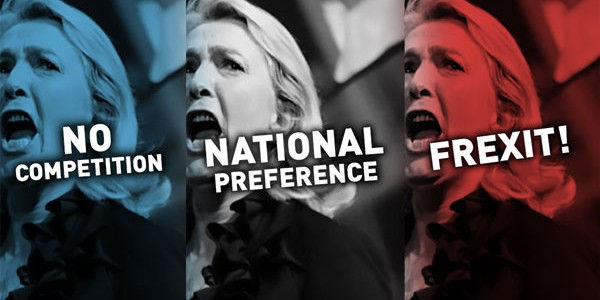
When it comes to economic policy, France’s Front National calls for a toxic cocktail of bank nationalizations, price controls, and overarching state planification.
The Front National’s (FN) rise in French politics is by no means a new phenomenon. For thirty years, it has been a subject of national conversation. From a fringe party, the FN has progressively grown first into a strong opposition force and now into France’s leading political party, taking 28% of the popular vote in Sunday’s regional elections. For the first time in French history, the FN might actually get a chance to implement its policies. While the FN is frequently warned about – and for good reason -, its economic proposals are rarely decried for what they are: a manifesto for a state-run, nationalistic economy [1]. GenerationLibre has, over a series of reports, carefully studied the FN’s economic proposals [2], a summary of which is presented in this paper. To understand just why the FN is such a cause for concern, let us let its economic policies speak for themselves.
A MISGUIDED DIAGNOSIS
The FN bases its economic policy on two initial observations.
– The French economy faces “unfair international competition” from “countries, which use currency manipulation and low social standards as a competitive advantage” [3] (i.e. emerging economies such as China). The facts disprove this hypothesis. In 2013, France’s combined trade deficit with Germany & Belgium amounted to 23 billion euros, more than the France – China trade deficit [4]. The FN manifesto points fingers at emerging countries for France’s trade deficit when, in reality, the major part of it comes from Eurozone partners.
– The French economy is suffering from “an explosion of industrial relocation [5]”. Looking at the facts, it turns out that over the 2009-2011 period, just 4.2% of companies based in France outsourced part of their operations abroad2, and such relocations have only been responsible for about 10% of job losses in past years.
A misguided diagnosis is followed by a fallacious set of policy proposals.
AGAINST GLOBALIZATION, THE CALL FOR A “SMART PROTECTIONISM”
The FN’s manifesto introduces the concept of “smart protectionism”, designed to be targeted at specific products and countries rather than across-the-board, traditional protectionism. The forms that this “smart” protectionism takes, however, are traditional:
– Tariffs and import quotas against “unfair international competition” [6];
– State opposition to foreign investors acquiring a controlling stake in French companies in “strategic sectors”2.
Overlooking the somewhat loose definitions of “unfair competition” and “strategic sector”, protectionist policies of this kind have proven time and again in history that they are harmful to the economies they wish to protect. They penalize not only consumers but also companies (by restricting their access to foreign goods or capital). In addition, they are almost inevitably followed by a backlash from other economies, which leads to isolationist spirals and leaves everybody worse off.
But what arguably constitutes the cornerstone of the FN’s economic manifesto is a Eurozone exit. The “end to the unfortunate Euro experience” is unambiguously called for. [7] As the argument goes, by returning to the Franc, France will be able to devaluate its currency, which in turn will boost the affordability of French products, thereby improve the trade deficit.
The FN concedes that such a Eurozone exit would be a “technical challenge”, and that foreign exchange controls (a ban on possession or use of foreign currencies in France) would need to be put in place [8].
The protectionist policies the FN puts forward can only be applied if the state has the means to apply them. And indeed, a common theme throughout the FN’s manifesto is a renewed stranglehold of the French state over the economy.
AN ECONOMY ENSLAVED TO THE STATE
To make its Eurozone exit possible, the FN is in favour of a “temporary & partial nationalisation of commercial banks”, which would prevent “speculation” and “clean up banking practices” [9].
The FN is also in favour of creating a new government department under the name “Strategic Planning of Re-industrialisation”, reporting to the Prime Minister [10]. Such a department would “organize French re-industrialisation” and dictate which direction the French economy ought to be guided in. To fund this state-led effort, a 15% income tax on France’s 50 largest market capitalisations would be introduced [11].
In an effort to increase the affordability of daily life for French consumers, the FN’s manifesto displays a range of top-down proposals. It supports an across-the-board wage increase for French workers and calls for an obligation for private companies to index wages on inflation [12]. It is also in favour of a 200€ rise for all “low wages” to “put an end to the terrible spiral of low income” [13]. Meanwhile, the 35-hour workweek remains unchanged [14], and a progressive return to the 60-retirement age [15] is argued for.;
Not satisfied with proposing draconian labour laws, the FN’s manifesto pushes the fallacy all the way, by calling for price controls. Some of these policies of a bygone era are almost amusing: costs of basic food products (such as bread and milk) are to remain within a given price range [16]. Electricity and gas prices are to be set by the state [17]. The cost of local public transport is not to go above a certain amount, determined by the state [18].
Whenever it gets a chance, the FN’s manifesto denounces “three decades of ultra-liberal ideology” [19], a “dictatorship of the market” and the “dogma of free competition”. How paradoxical, then, that the FN proposes to “reinforce competition authorities and introduce tougher antitrust sanctions [20]“. The very concept of competition, central to any free market, runs counter to the kind of economy the FN calls for.
Commentaires